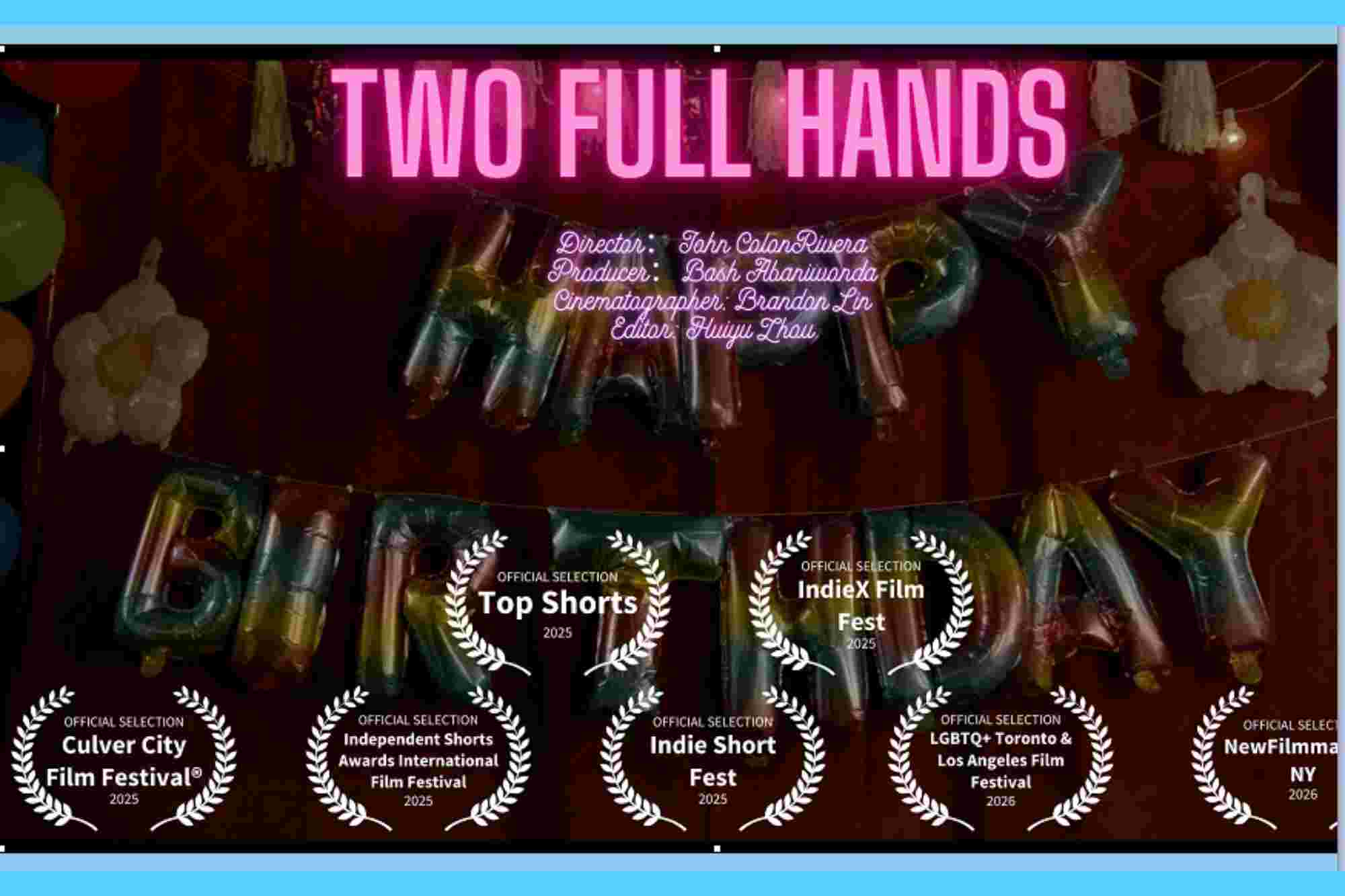
Among the recent independent shorts drawing attention on the festival circuit, Two Full Hands stands out for both its strong reception and its emotional clarity. The film received an award at the Top Short Film Festival, followed by an official selection at the Culver City Film Festival and a semi-finalist placement at IndieX Film Fest. Directed by John Colón Rivera, produced by Bash Abaniwonda, written by Pedro Riera, photographed by Brandon Lin, and edited by Huiyu Zhou (Jade), the short has been recognized for the honesty and emotional depth with which it portrays ordinary struggle. At the center of the film is a reality many people will recognize immediately: the strain of trying to hold together work, family, and emotional stability at the same time.
Focused on a single mother navigating the pressures of daily life, Two Full Hands looks closely at exhaustion, interruption, and the kind of responsibility that leaves little room for rest. At the same time, it makes space for something quieter but equally important: the kindness of strangers, and the possibility that care and belonging can exist beyond blood ties. That combination of hardship and human connection is part of what gives the film its emotional weight and broader social resonance.
Made under modest conditions, Two Full Hands does not try to hide the circumstances of its production. Produced with limited resources, changing locations, and performers without formal acting training, the film allows those conditions to remain visible on screen. Its simple production design and raw performances become part of its texture, keeping the story close to the pressures and uneven rhythms of everyday life.
Part of that effect comes from the way the film was made. Working with performers who had no formal acting training, director John Colón Rivera allowed scenes to develop through long takes, often resetting so actors could gradually settle into the moment rather than being pushed too quickly into a tightly controlled rhythm. That process resulted in footage marked by hesitation, uneven timing, and small shifts in behavior. In the edit, Huiyu Zhou brings shape to those fragments without stripping them of their emotional honesty. Rather than forcing the material into artificial smoothness, her editing draws attention to pauses, fleeting expressions, and small gestures that help the film hold onto its sense of human vulnerability.
What emerges is a film whose unevenness becomes part of its intimacy. The performances are inconsistent at times, but that quality also makes them feel vulnerable and immediate. By staying close to the strain of balancing care, work, and survival in everyday life, the film reflects an emotional reality that is both personal and widely familiar.
That is where Two Full Hands carries broader social meaning. Its story is not built around spectacle or dramatic resolution. Instead, it pays attention to burdens that often remain invisible: the emotional strain of caregiving, the pressure of economic and domestic responsibility, and the quiet resilience required to keep moving forward. Just as importantly, it suggests that support does not only come from family structures but can also appear through brief acts of generosity and recognition from others.
What stays with viewers after Two Full Hands is not only its hardship, but its honesty. By remaining close to strain, vulnerability, and small acts of care, the film offers a portrait of contemporary life that feels restrained, intimate, and socially resonant. In a time when many people are living under constant pressure, Two Full Hands reminds us that ordinary endurance is itself a powerful subject, and that even within instability, moments of connection still matter.
Please explore our site for more exciting content if you like this article..