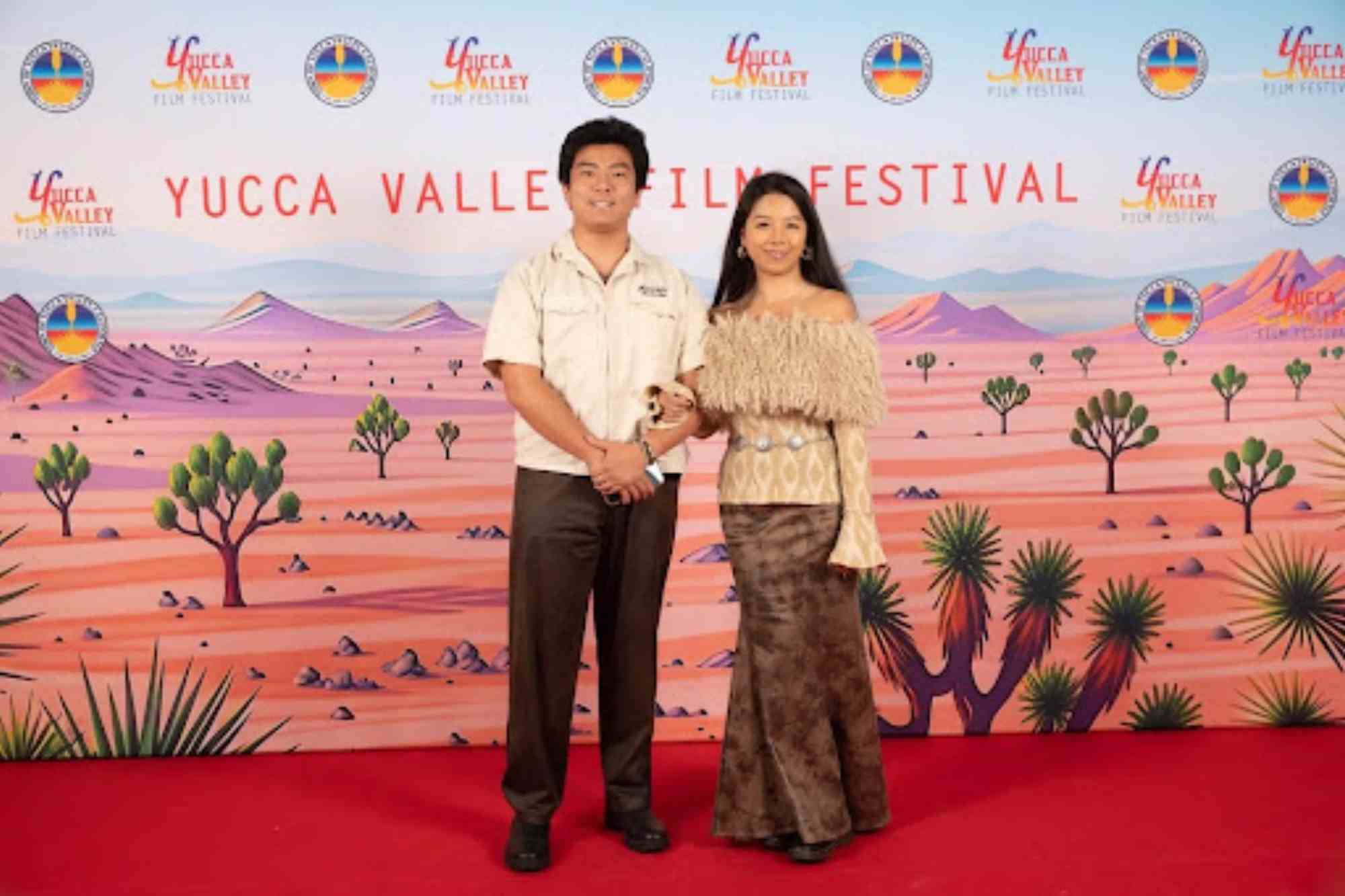
From November 7–9, 2025, at the 7th Yucca Valley Film Festival, Desert Inn screened to a house that understands desert light better than most. Yucca Valley is the natural gateway to Joshua Tree National Park, an area that welcomed 2.9 million visitors in 2024, and it also serves as the economic hub of the Morongo Basin. It offers the beauty of the low desert with the seasonal advantages of the high desert, and its rhythms are set by artists who come here to make work and meet a receptive audience.
Founded in 2019, the festival has become a family-friendly annual rendezvous for the Hi-Desert community, film lovers, and art audiences. What began with three packed screening nights, and a red carpet has expanded to a three-day program that, in 2025, gathered close to 1,500 festivalgoers, drawing international filmmakers and sustained press coverage. The town’s own screen history runs deep as well, with more than 50 titles listing scenes shot in the area, from the historic sets of Pioneertown to major productions such as Tim Burton’s Miss Peregrine’s Home for Peculiar Children, which filmed portions on Old Woman Springs Road in 2016.
Within this context, Desert Inn fit not as an outlier but as a clear conversation partner. The film’s dramatic architecture, centered on two men with opposing ideologies inside a desert hotel, meets a place where geography and light already carry narrative weight. Instead of restating plot, the program framed how the picture uses contrast, controlled framing, and silence to let space speak. That emphasis aligned with local viewing habits shaped by the desert’s stark clarity and the way sun and shadow can redraw a room by the minute.
Cinematographer Yuanhao Zhang, whose work on Desert Inn has been widely recognized across major short-film festivals, attended the screening and took part in a post-film Q&A, discussing practical choices that align with the festival’s landscape-first sensibility, including shot planning that respects the sun’s position and compositions that separate characters psychologically without relying on dialogue. As he noted during the Q&A, “cinematography can have character,” a point that resonated with a community accustomed to reading environment as text.
In practice, Zhang committed to a natural-light-first strategy. Working in a confined, desert-located luxury house, he designed meticulous shot lists and lighting plans to render the setting as a smart, almost sci-fi hotel. With a limited budget, sunlight served as the primary source, and every setup was aligned to the sun’s path. The April schedule introduced a narrow late-afternoon window in which daylight falls off within about fifteen minutes, which required precise timing, disciplined camera placement, and compositions that assign each character a distinct visual territory. On screen, direct sunlight yields interiors with a near-astronautic clarity; wide shots emphasize sterile, spacious emptiness, while tighter coverage isolates gesture and reveals vulnerability. By managing contrast, shadow, and spatial framing, Zhang lets ideology read as architecture, and he noted that despite the constraints, the team ultimately captured every shot they intended.
The result was a demonstration of fit, as the film’s visual language, marked by precision in light, disciplined composition, and a measured sense of tension, found a setting defined by place, history, and a festival built for work that treats space as story. At Yucca Valley, Desert Inn was not simply screened but fully situated within a culture of viewing shaped by desert horizons and by a festival that has, since 2019, provided a home for films that let light do the talking.
Please explore our site for more exciting content if you like this article..